


Planning warehouse space is one of the most common challenges for growing supply chains. Whether you’re evaluating a new facility, comparing storage methods, or trying to understand how many pallets a building can realistically support, estimating the right amount of square footage can be difficult without a quick planning tool.
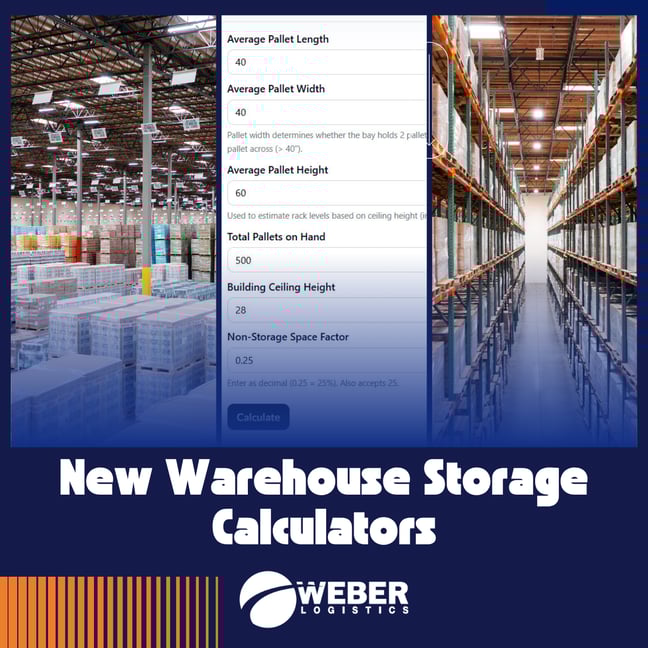
To make this process easier, Weber Logistics has launched two new online tools: a Bulk Storage Calculator and a Racked Storage Calculator. These calculators help you quickly estimate the warehouse space required for pallet storage based on common warehouse design assumptions.
Both tools are designed to provide fast planning estimates that can support early facility decisions, layout comparisons, and discussions with logistics partners.
Bulk Storage Calculator
 Bulk pallet storage is commonly used when pallets can be stacked directly on the warehouse floor. This method is frequently used for stable, uniform products that can be stacked two or more pallets high.
The Bulk Storage Calculator estimates warehouse space requirements using a standard bulk storage layout that assumes:
- An 8-pallet-deep storage bay
- A 10-foot operating aisle
- A typical pallet footprint of 4 feet deep
- A calculated bulk bay depth of 32 feet
Using these assumptions, the calculator estimates total square footage based on:
- Average pallet size
- Total pallets on hand
- Stack height
- Non-storage space allowance for docks, offices, staging, and forklift movement
This allows users to quickly estimate how much floor space is required for bulk pallet storage under common warehouse operating conditions.
Try the calculator: Bulk Storage Square Footage Calculator
Racked Storage Calculator
Pallet racking is one of the most widely used warehouse storage systems because it allows direct access to individual pallets and efficient use of vertical space.
The Racked Storage Calculator estimates warehouse space requirements for single-deep selective rack systems. The tool incorporates several common racking design assumptions, including:
- Standard rack beam width (96 inches)
- Upright allowance (4 inches)
- A total rack bay width of 100 inches
- A 10-foot aisle for lift truck operation
- Vertical clearance allowances between pallet levels
The calculator also adjusts for pallet width to determine whether the rack bay holds one pallet or two pallets across, which can significantly impact storage density.
Users can input:
- Pallet dimensions
- Total pallet count
- Building ceiling height
- Non-storage space allowance
The calculator then estimates:
- Total warehouse square footage required
- Square feet required per pallet position
Try the calculator: Racked Storage Square Footage Calculator
Why These Tools Matter
Warehouse space planning typically requires detailed layout design, but early-stage planning often benefits from quick, realistic estimates. These calculators are designed to provide a practical starting point by using common warehouse layout assumptions that reflect real-world operations.
They can help answer questions like:
- How much warehouse space will my pallet inventory require?
- Should I consider bulk storage or pallet racking?
- How does stacking height affect the space I need?
- What impact does non-storage space (e.g., docks, offices, staging areas, and forklift aisles) have on facility size?
While the results are intended for planning and comparison purposes, they can be extremely helpful for teams evaluating warehouse capacity or exploring outsourced logistics solutions.
Planning Warehouse Space with Weber Logistics
At Weber Logistics, warehouse design and storage optimization are core parts of helping customers build efficient distribution networks. From bulk floor storage to high-density racking systems, our team helps companies determine the right storage strategy for their products, inventory profiles, and operational needs.
If you’d like help evaluating your specific storage strategy or understanding how much space your operation may require, our team would be happy to help.
Contact Weber Logistics to speak with a warehousing expert.
DISCLAIMER: The information generated by these calculators are intended for general informational purposes only and does not constitute engineering, operational, or facility design advice. Weber Logistics makes no guarantees regarding the accuracy or applicability of these estimates to any specific operation.






 Capital Management