


If you know anything about Weber Logistics, you likely know that our integrated warehousing, transportation and port services include drayage from the Ports of Los Angeles/Long Beach. Weber knows the LA/LB complex like the back of our collective hand as we dray close to 10,000 containers per year coming into the country’s busiest port complex.
What you may not know, however, is that we’re equally adept at handling port services such as drayage and transloading further North at the Port of Oakland. In this article, we’ll take a closer look at these services and explain why this Northern California port – which ranks in the top 10 in terms of U.S. volume – may be a good choice for your imports.
The Port of Oakland’s 2025 performance
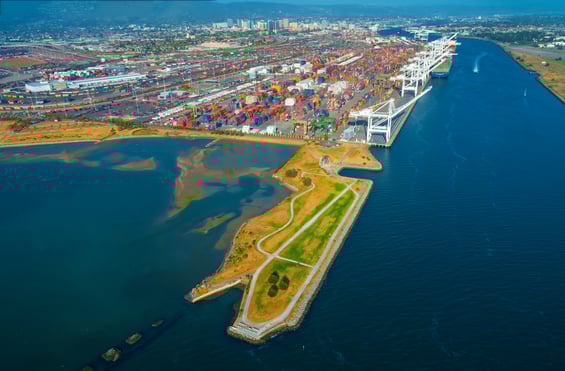 After a tumultuous few years marked by changing trade policies, equipment shortages, and ongoing uncertainty, the port closed out calendar year 2025 with remarkably stable cargo volumes.
Handling 2,253,976 TEUs (twenty-foot equivalent units), just a 0.4% decline year-over-year, Oakland demonstrated that even amid global volatility, balanced throughput and reliable service are possible. Its cargo profile was also noteworthy for the nearly even 50/50 split between imports and exports, with imports dipping slightly (-0.9%) while exports edged up (+0.1%). This balance underscores the port’s role not just as an import gateway, but as an engine for U.S. export growth, particularly for products like foods, beverages, and agricultural commodities where Oakland has long held geographical advantages.
Many analysts view 2025’s results as stabilization more than dramatic growth, which is ultimately a strategic win in a market that saw significant trade policy turbulence and shifts in shipping patterns. For instance, December’s volumes were down modestly — total TEUs fell 1.7% and loaded imports slid more sharply (-12.8%) — but these movements were offset in part by a notable rise in exported containers (+10.9%).
In this environment, reliable inland transportation, consolidated warehousing, and fast turn times aren’t just nice-to-have capabilities—they’re operational must-haves.
Why Oakland’s Geography and Logistics Infrastructure Still Matter
For companies importing and exporting through Oakland, proximity and distribution strategy reduce costs and speed performance. California’s Central Valley, in particular, continues to shine as a strategic inland distribution hub thanks to its cost advantages and geographic reach. Located just east of the Bay Area and within about 70 miles of the Port of Oakland, the Central Valley allows companies to serve major West Coast markets while avoiding huge Bay Area real estate premiums. This is no small benefit as warehousing costs in many Bay Area markets can be more than double what you would pay in the Valley, making Stockton and surrounding areas a clear choice for companies prioritizing cost savings without sacrificing speed.
This location advantage also supports rapid over-the-road distribution to destinations throughout California, Nevada, and the Pacific Northwest within a single day—something that can be especially valuable when balancing drayage costs with broader freight economics.
The Strategic Value of an Integrated 3PL Partner
Here’s where an integrated third-party logistics (3PL) provider adds meaningful value. Modern logistics isn’t about siloed service lanes; it’s about end-to-end orchestration. Whether that’s drayage from the port, consolidation in a warehouse, or final-mile delivery, having a single provider manage the flow can streamline operations and reduce friction.
For example, Weber Logistics’ Stockton warehouses sit in the heart of the Central Valley with direct access to major freeways like I-5 and CA-99. These facilities support everything from refrigerated food and confectionery products to CPGs, and offer value-added services such as repackaging, labeling, and kitting—all designed to simplify distribution once cargo leaves the port.
More importantly, such an integrated operation enables you to simplify your supply chain through the support of a single 3PL partner. Need the warehouse to open after hours to receive an incoming container? Need to bump up an outbound shipment from the warehouse to accommodate a retailer? Your integrated 3PL can do those things seamlessly as it controls all elements of the distribution process.
This type of integration helps you to:
- Enjoy lower costs – in addition to lower Central Valley warehousing costs, drayage from the Port of Oakland to the Valley can cost up to $1,000 less than drayage from the Ports of LA/LB to the Inland Empire
- Reduce unnecessary waiting times
- Turn containers faster (avoiding detention and demurrage fees)
- Scale up to meet seasonal demand spikes or market changes
Turn to Weber Logistics for Integrated Services to/from The Port of Oakland
Whether you’re a multinational importer/exporter or a mid-sized regional supplier, aligning with logistics providers that can smooth port transitions, optimize inland distribution, and manage cost variables will increasingly be a differentiator—not just a ‘nice to have.’
If you’re interested in exploring what the Port of Oakland has to offer your supply chain, contact Weber today. We’d be happy to have a conversation and see if a Northern California logistics operation is the right fit for your company.


 Capital Management